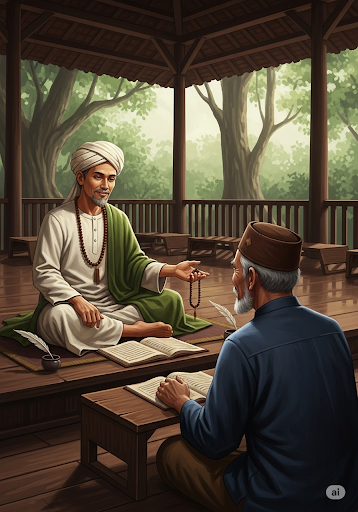
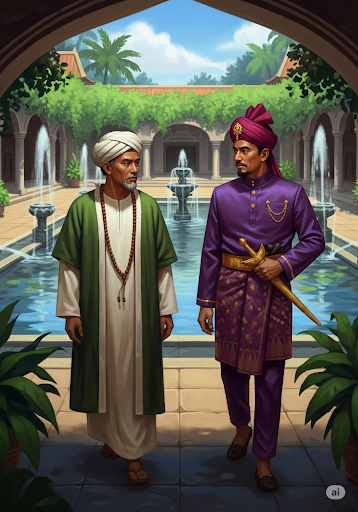
For many years, Hamzah served as a trusted advisor to the mighty Sultan Iskandar Muda. Under the Sultan’s shadow, the arts and sciences flourished. They would walk through the palace gardens, discussing the nature of the divine and the destiny of the kingdom. The Sultan looked upon Hamzah not just as a subject, but as a compass that pointed toward the truth, ensuring the empire’s heart remained as strong as its walls.
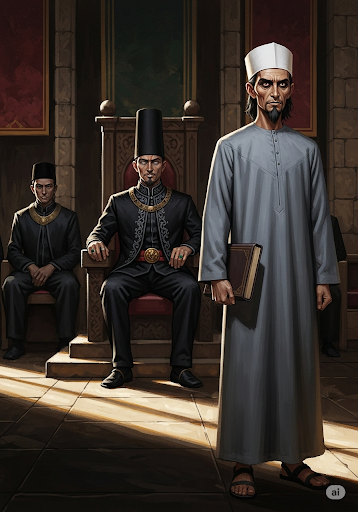
But the winds of time eventually shifted. When Sultan Iskandar Muda passed into legend, the throne was taken by Sultan Iskandar Thani. Beside him stood a new advisor, Nuruddin Ar-Raniry, a man of rigid law and stern conviction. The atmosphere in the court grew heavy and sharp. Where there was once a dialogue of poetry and mysticism, there was now the cold steel of strict interpretation.
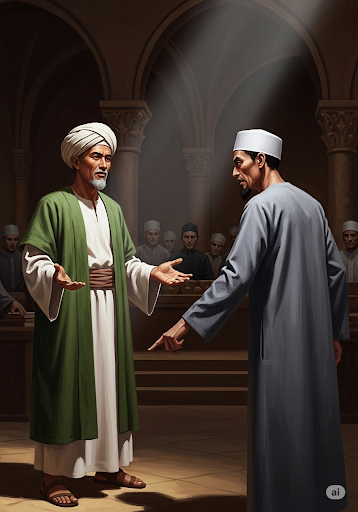
Tension boiled into conflict as Nuruddin Ar-Raniry publicly challenged Hamzah’s teachings. He labeled Hamzah’s mystical poems as heresy, claiming they blurred the lines between the Creator and the created. The two scholars met in the court, their words clashing like swords. Hamzah defended the light of inner knowledge, but Nuruddin’s influence over the new Sultan was absolute, and the decree was signed in ink that smelled of ash.
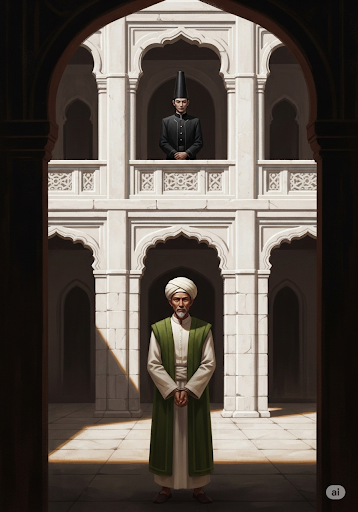
The trial reached its zenith before the grand gates of the palace. Sultan Iskandar Thani looked down from his balcony, his face unreadable as the sentence was read aloud. Hamzah Fansuri was found guilty of wandering too far into the depths of the divine. He was sentenced to die by the blade at the courtyard of the Baiturrahman Grand Mosque, a place that had once echoed with his own prayers.
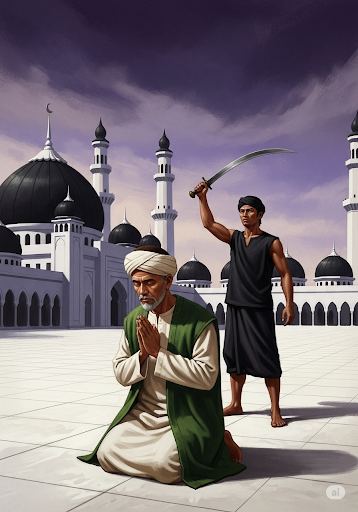
On the day of the execution, the sky over the Baiturrahman Grand Mosque was a bruised purple. A massive crowd gathered, hushed by a sense of impending tragedy. Hamzah knelt upon the earth, his spirit seemingly already elsewhere. As the executioner’s blade fell, a gasp tore through the silence of the city. The scholar’s life was claimed, but the story was only beginning.
He walked through the village paths and toward the coastline, passing through the area we now know as Ulee Lheu. The name itself was born of this moment, meaning "The Released Head." The villagers watched in holy terror and awe as the scholar traversed the sands, his spirit refusing to depart until it found the ground where it truly belonged.
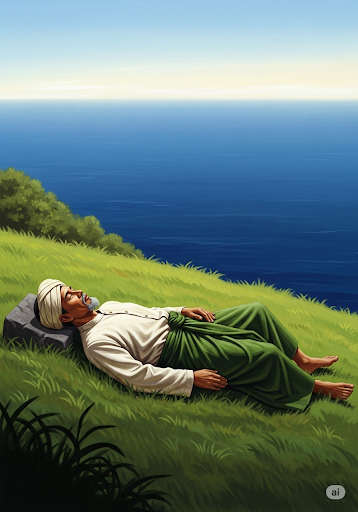
Hamzah finally reached the foot of a high hill near Ujong Pancu. There, overlooking the vast expanse of the Indian Ocean, his journey came to its end. He laid down upon the earth, and at long last, the scholar found his rest. He was buried on that hill, far from the politics of the court, where the wind sings through the trees and the salt spray cleanses the air.
To this day, the grave of Hamzah Fansuri remains a place of pilgrimage, marked by a simple stone without a cross, in accordance with his faith. Legend tells that the site is never truly empty; it is guarded by a majestic white tiger that roams the hill, a silent sentinel protecting the remains of the man who walked with his head to find his home.