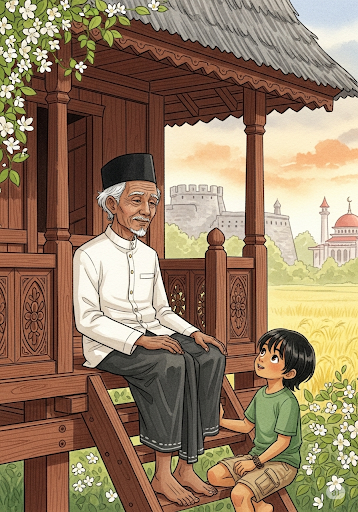
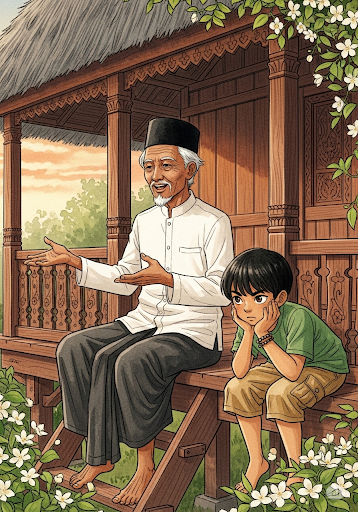
Kakek Abu sat on the carved wooden porch of his traditional Aceh house, the evening air smelling of jasmine and salt. His grandson, Agam, sat cross-legged at his feet, eyes wide with wonder. "Long ago, Agam," Kakek Abu began, his voice like the steady hum of the tide, "in the fertile land of Aceh, there were three special regions called mukims. These were Mukim XXV, Mukim XXVI, and Mukim XXII. Each one was a beating heart of civilization, centered around a grand mosque that held the soul of the people."
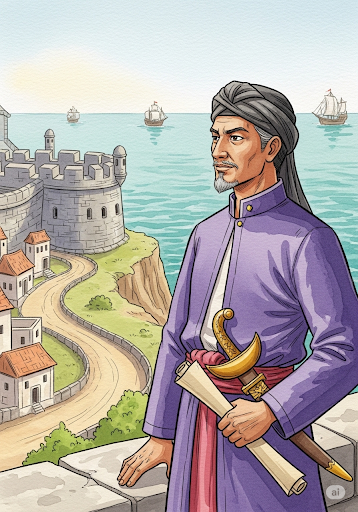
"The first was Mukim XXV, known as Indrapurwa," Kakek Abu continued. "It stood proudly along the road to Lhoknga beach. It was led by Malik As-Saleh, a leader so wise and intelligent that he was chosen as the Prime Minister to handle all foreign affairs. He turned the area into a 'Kuta'—a strong city. There was a mighty fort there and a mosque where travelers from far-off lands would gather to trade and talk. Today, a green golf course sits where the old fort once guarded the coast, but the echoes of the Prime Minister’s wisdom still linger in the wind."
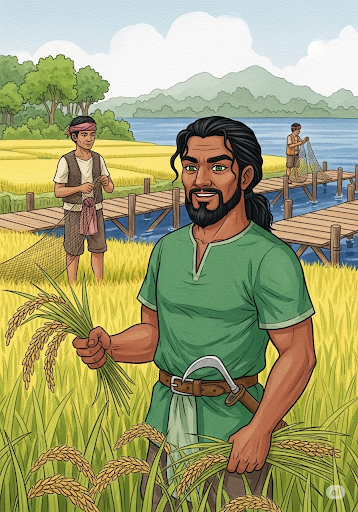
"Then there was Mukim XXVI, called Indrapatra, located in Krung Raya," said Kakek Abu. "It was led by Malik Al Hayat, a man whose name meant 'Life' itself. He was a king who cared for the 'Alam'—the nature that fed his people. Under his gaze, the fields turned gold with rice, and the nets of the fishermen came up heavy with silver fish. He managed the forests and the sea, ensuring that no one ever went hungry. His fort was a center of life where the earth and the ocean met in harmony."
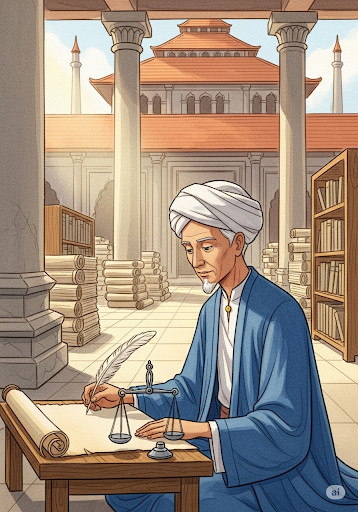
"Deep inland lay Mukim XXII, known as Sagoe Indrapuri," Kakek Abu whispered, his face turning solemn. "It was the land of 'Qanun,' or Law. Led by the just Qadhi Malikul Adil, this was the place where the rules of the land were forged. Every big decision about Aceh’s future was debated here, within the walls of its sacred spaces. It was a place of fairness, where the scales were always balanced and everyone, from the poorest farmer to the wealthiest merchant, was treated with the same respect under the law."
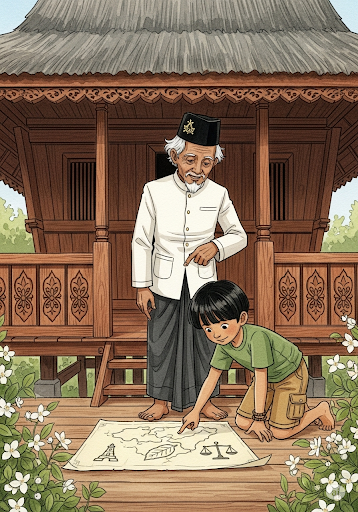
Agam looked up at his grandfather. "So, Kuta, Alam, and Qanun... City, Nature, and Law?" Kakek Abu nodded proudly. "Exactly, Agam. From these three pillars, the very motto of Aceh was born. A civilization needs a strong city to grow, nature to sustain it, and law to keep it fair. Without one, the others would surely crumble. They were like the three legs of a sturdy stool, holding up the great kingdom of Aceh for all the world to see."

"But where did they all meet?" Agam asked. Kakek Abu pointed toward the distant horizon. "In the center of it all stood the Baiturrahman Grand Mosque in Kuta Raja. This was the neutral zone, a place of peace that oversaw all three mukims. It was the anchor of the entire region. People from Indrapurwa, Indrapatra, and Indrapuri would all come together there to pray and find common ground. It was the jewel of the kingdom."

"Eventually, people from far away across the ocean—the Dutch—arrived in our lands," Kakek Abu said. "They were amazed by what they saw. They looked at our progress, our laws, and our cities and compared us to Great Britain! Because there were three main regions, they called us 'Lhee Sagoe,' which they translated into their own language as 'Groot Aceh,' or Great Aceh. They knew they had stepped into a place of true greatness."
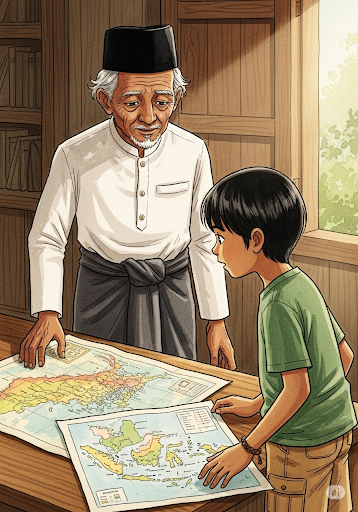
Kakek Abu’s voice grew a little sadder. "After many years and many changes, when Aceh became part of Indonesia, the name 'Aceh Raya' was changed to 'Aceh Besar.' It sounds similar, but the meaning of 'Raya'—the Great Kingdom that once traded with Turkey and ruled the seas—was slowly forgotten. To many, it became just a small district on a map, and the stories of the Three Mukims began to fade like old ink on paper."
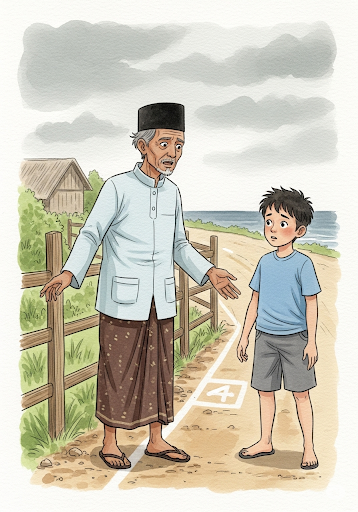
"But there was a new challenge," Kakek Abu warned. "Some newcomers, who didn't understand our history, wanted to break the land apart. They wanted to take Mukim XXV and turn it into something else, separating it from the others. If they did that, the 'Three Sagis' would no longer be whole. The history of Lhee Sagoe would be erased, and the ancient bond between the City, the Nature, and the Law would be broken forever."

Agam didn't want the history to disappear. He found Sabat and the other children in the village. "We have to do something!" Agam cried. They decided to become the guardians of the story. They spent their afternoons talking to everyone they met, reminding them that Indrapurwa, Indrapatra, and Indrapuri were meant to stay together. They drew pictures of the three leaders and wrote down the motto: Qanun, Kuta, Alam. They worked to make sure the unity of Lhee Sagoe was never forgotten.
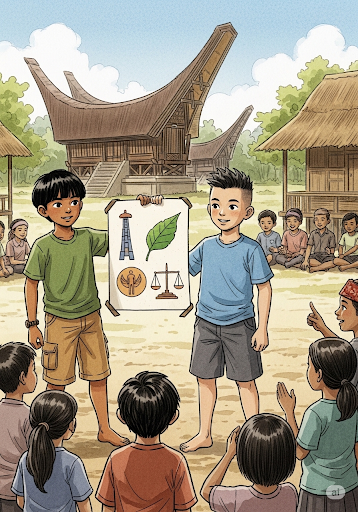
Because of the hard work of the young people, the community began to remember. They realized that their strength lay in their shared past. They stood together to protect the borders of their history, ensuring that the three mukims remained intact. The legend of the Three Sagis was no longer just a story told on a porch; it became a living part of their identity once more, a shield against those who wished to divide them.
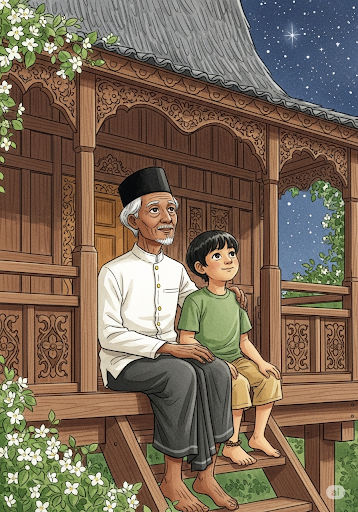
Kakek Abu smiled and patted Agam’s shoulder. "My hope is that this legend lives on in you, Agam, and in all who come after. As long as you remember the wisdom of Malik As-Saleh, the life-giving nature of Malik Al Hayat, and the justice of Qadhi Malikul Adil, Aceh will always be Great." Agam nodded, looking out at the stars, knowing that he was now a part of the long, proud history of the Three Mukims.

 Share
Share